
RENTERS' RIGHTS HUB | LANDLORD EDITION
The Renters’ Rights Act represents the most significant shift in housing legislation since 1980 — and with major change comes important questions.
To support you through this transition, we’ve partnered with your letting agent to bring all the key information together in one place. From direct links to the official Act to clear, easy-to-read infosheets, our goal is to ensure you feel informed and confident as a landlord heading into 2026.
GET RENTERS' RIGHTS READY | LATEST UPDATE
On 14 October 2025, the Government announced the official implementation date and rollout timeline for the Renters’ Rights Bill. The reforms will be introduced in three phases. Phase 1, which includes the abolition of Section 21 evictions and the transition to open-ended periodic tenancies, will come into effect on 1 May 2026. Further changes will be introduced throughout the remainder of 2026, with additional measures continuing into 2027 and beyond. For the full details, please visit the GOV.UK website using the link below.
KEY INFORMATION & UPDATES
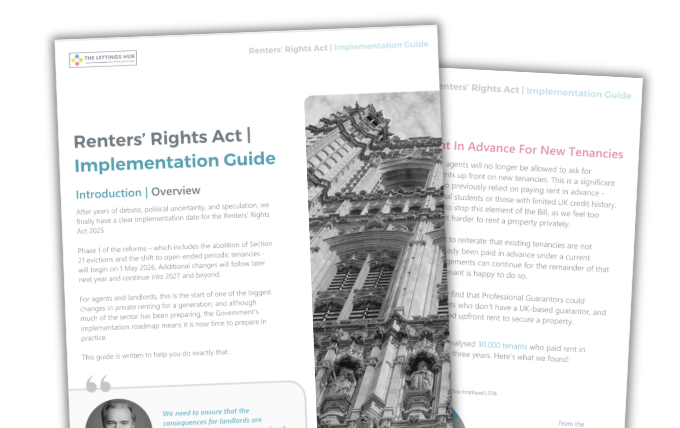
The Timeline | Infosheet
We talk you through the key changes of the Renters' Rights Act and when they will come into force.
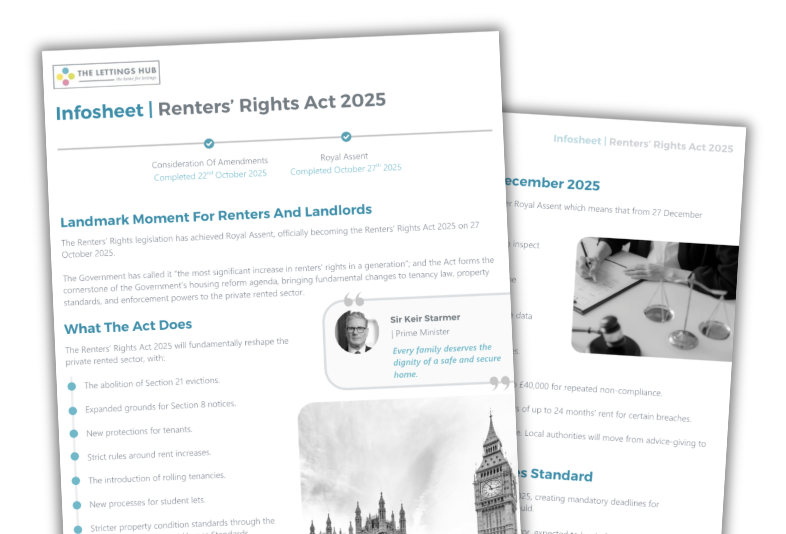
The Key Changes | Infosheet
In this document we look at the key changes, the impact on the market and what you need to do to prepare.
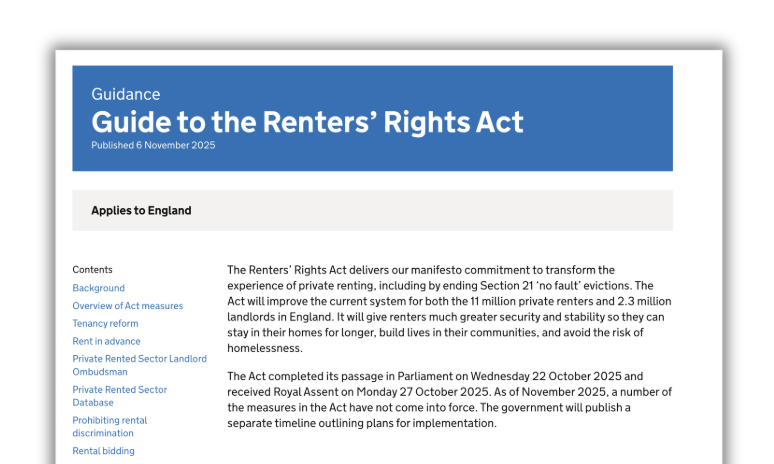
Guide to RRA | GOV.uk
View the Governments Guide to the Renters' Rights Act.
FAQ | WHAT YOU NEED TO KNOW
No. Existing tenancy agreements do not need to be replaced.
This has been a major misconception, as many were expecting that new tenancy agreements would need to be issued overnight. However, this is not the case.
All current fixed-term and periodic ASTs will automatically convert into the new periodic tenancy model, regardless of their end date and agents will be required to issue the guidance provided by the Government in Spring 2026.
Yes. It is expected that by 31 May 2026, landlords must give existing tenants a copy of a government-produced information sheet, which is set to be published in early 2026.
This is one of the most important rules to consider now.
- If a landlord serves a valid Section 21 notice before 1 May 2026, it remains valid.
- The notice may still be acted upon after 1 May, provided the notice was served correctly, it has not expired and all procedures were followed.
- After 1 May, no new Section 21 notices can be issued.
- If a Section 21 notice served expires by 1 May, it becomes invalid and a Section 21 can not be re-issued.
This makes early planning essential. If a landlord is considering using Section 21 for an existing letting, they should act well before the 30th April deadline to avoid slipping into the new regime unintentionally.
The tenancy will not end unless it is ended by the tenant, or it is ended by a Section 8 notice, using one of the expanded grounds. Once the fixed term finishes, then the tenancy simply becomes a periodic tenancy.
Any six-month tenancy granted from 1st November onwards will now continue beyond 1st May unless the tenant serves notice to leave, which means it won’t end on its contractual date. Instead, it will automatically convert into the new periodic tenancy model as soon as the reforms take effect.
Tenants can still be asked to leave; just not without a valid reason. A well-evidenced Section 8 will become the only a route to possession. The expanded grounds should mean vacant possession can still be secured in the event of serious rent arrears, anti-social behaviour or if a landlord wants the property back to sell, or if they or a close family member wants to move in.
Yes, but:
- Only once per year
- Only by using a Section 13 process
- Tenants are able to challenge excessive increases at tribunal – which created some uncertainty and criticism during the debate stages in Parliament.
Landlords used to percentage-based increases written into agreements may find the formal Section 13 process unfamiliar, so agents will need to guide them carefully.